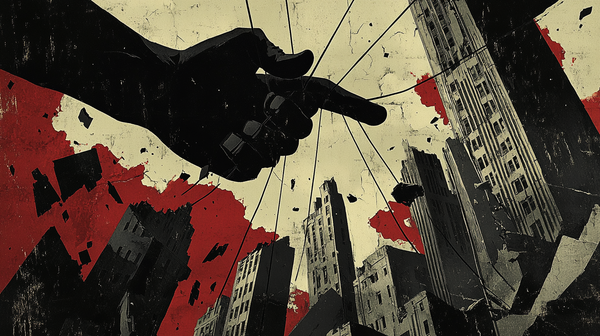
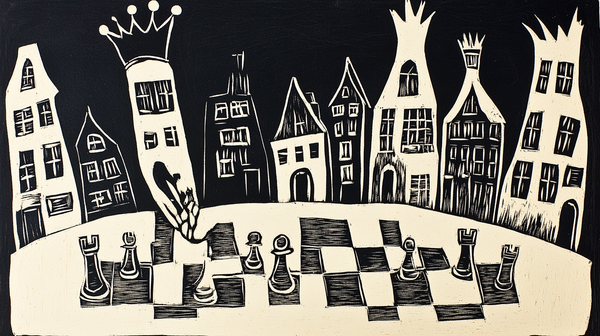
Division as Technology: The 400-Year Engineering Project That Built American Racism
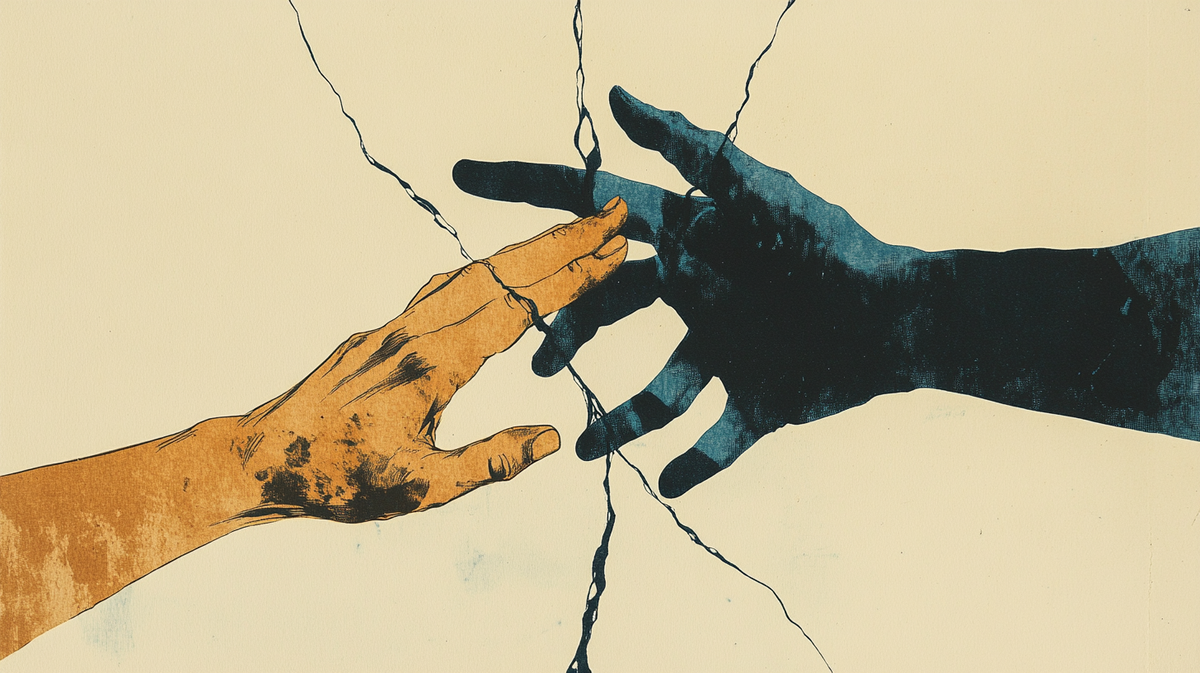
The Uncomfortable Discovery
There is a version of American history most of us absorbed without questioning it. In that version, racism is an ancient prejudice, a moral failing baked into human nature that colonists carried across the Atlantic like a virus. It existed before America and would have existed without it. The best we can do is manage it, contain it, and hope each generation improves.
That version is substantially wrong.
The historical record tells a different story. One that is, in many ways, more disturbing than the conventional narrative, because it replaces a tragedy of human nature with something far more deliberate. American racism, particularly the anti-Black racial caste system that defined the nation's first 250 years and still shapes its institutions today, was not an inherited cultural trait. It was engineered. Constructed through specific legislation, by identifiable people, to solve a specific economic problem.
The problem was this: how do you maintain a system of extreme wealth extraction without being overthrown by the people you are extracting from?
The answer, developed over decades of trial and error in colonial Virginia, was division. And the technology they built has been running, with periodic upgrades, ever since.
The Virginia Laboratory
The strongest evidence for racism as a manufactured system comes from the colony where it was most clearly assembled: Virginia between 1620 and 1705.
The early colonial labor force looked nothing like what most Americans imagine. English indentured servants worked alongside smaller numbers of enslaved and indentured Africans. The historical record from this period, preserved in court documents, property records, and legislative minutes, reveals several facts that are difficult to reconcile with the idea that racial hierarchy was a pre-existing condition.
Interracial solidarity was common. Poor white and Black laborers worked together, socialized together, ran away together, and formed families together. Court records document this extensively. Legal distinctions based on race emerged gradually, not all at once. In the 1640s, some Africans in Virginia owned property, sued in court, and even held indentured servants themselves. Anthony Johnson, a Black man who arrived as an indentured servant, became a landowner and slaveholder. The rigid racial binary that would later define American society simply did not exist yet.
What changed was Bacon's Rebellion.
In 1676, a multiracial coalition of poor laborers, both Black and white, rose up against the planter class. The rebellion was chaotic, violent, and ultimately unsuccessful. But it terrified the colonial elite in a way that no previous crisis had. The problem was not the rebellion itself. The problem was who had united against them.
In the aftermath, the Virginia legislature began passing laws that systematically separated Black and white laborers. Intermarriage was prohibited. Free Black people were stripped of rights they had previously exercised. Poor whites were given new legal privileges over Black people regardless of economic status. The progression was deliberate and documented. It culminated in the Virginia Slave Codes of 1705, which formalized a comprehensive racial caste system into law.
This was not ancient tradition being codified. It was new legislation, passed by identifiable legislators, in response to a specific political crisis, designed to prevent a specific type of coalition from ever forming again.
Edmund Morgan's American Slavery, American Freedom, published in 1975, traces this sequence in rigorous archival detail. It remains one of the most influential works of American history ever written, and the Virginia evidence it assembles is about as close to a smoking gun as history gets.
The Three Mechanisms
What the planter class engineered in Virginia was not a single innovation but a system with three interlocking components. Each reinforced the others, and together they created something remarkably durable.
The first mechanism was labor extraction at scale. Chattel slavery was the most extreme form of labor cost suppression ever devised. It was not merely "cheap" labor. It was labor where the worker was the capital asset. An enslaver could extract work, breed more capital, and use human beings as collateral for loans. By 1836, enslaved people's bodies represented more capital value than all American railroads and factories combined. Cotton produced by enslaved labor accounted for over half of all U.S. exports. Financial instruments resembling modern mortgage-backed securities were created using enslaved people as collateral. The system was not peripheral to American capitalism. It was the engine.
The second mechanism was the division of the working class through manufactured racial hierarchy. This is the innovation that made the system self-sustaining. After Bacon's Rebellion, the Virginia legislature gave poor whites just enough legal and social status over Black people to prevent future solidarity. W.E.B. Du Bois, writing in Black Reconstruction in 1935, called this the "psychological wage of whiteness." Poor white workers received almost nothing in material terms. But they were compensated with status, the knowledge that no matter how poor, how exploited, how miserable their conditions, they were legally and socially above Black people. That status substitute functioned as a release valve against class solidarity. It ensured that poor whites would defend the system rather than challenge it, because their only social capital depended on its survival.
The third mechanism was the recruitment of the poor as enforcers. Poor whites were not just passively divided from Black laborers. They were actively recruited as overseers, slave catchers, and militia members. Slave patrols, which were literally the origin of organized policing in the American South, gave poor whites material incentives through small payments and land grants, and psychological incentives through authority and status, to actively enforce the system. This made it partially self-policing. The ruling class did not need a massive standing army to maintain slavery. They had engineered a society where a significant portion of the oppressed class volunteered to maintain it.
The elegance of this system, from a power-preservation standpoint, is breathtaking in its cynicism. You do not have to pay people well if you can convince them that their real enemy is the person chained next to them rather than the person holding both their chains.
Engineering, Not Invention
A critical question emerges from this history: did the colonial elite invent this strategy, or were they applying something older?
The honest answer is that they were engineers, not inventors. The strategy of dividing subordinate classes is ancient. Divide et impera was documented Roman administrative policy. England had practiced it domestically through its class system and rehearsed it colonially in Ireland, where religious division between Protestants and Catholics was deliberately cultivated to prevent a unified Irish resistance. Sun Tzu articulated the core principle around 500 BC. Machiavelli codified it. The British Empire ran on it across four continents.
What the Virginia planter class did was apply known principles to a new variable, phenotype, in a new context, plantation capitalism in the Americas. They took pre-existing European biases about skin color, which existed but were relatively unstructured, and forged them into a comprehensive legal and economic caste system. The raw materials were not new. The engineering was.
Think of it less as a single brilliant invention and more as an iterative development process. The "problem" was structural: how to maintain extreme extraction without provoking revolution. The "solution" was tested, refined, and scaled over decades. Laws were passed, repealed, and revised. Social boundaries were drawn, enforced, and hardened. The system did not arrive fully formed. It was built through accumulation.
And like any technology, it was adopted because it worked.
The Broader Evidence
The Virginia case study is the most granular, but the broader economic evidence reinforces the argument from every angle.
Eric Williams, in Capitalism and Slavery (1944), made the quantitative case that the transatlantic slave trade and plantation slavery were not peripheral to capitalist development. They were central to it. Sven Beckert's Empire of Cotton (2014) documented how slave-produced cotton was the single largest commodity in global trade by the mid-1800s, and that industrial capitalism in Britain and New England was directly financed by it. Edward Baptist's The Half Has Never Been Told (2014) provided granular accounting of how enslaved labor was not simply a Southern institution but was deeply integrated into Northern banking, insurance, and manufacturing.
The financial archaeology is particularly damning. Wall Street and major banks including JPMorgan Chase have acknowledged historical ties to slavery-era finance. The insurance industry was built, in significant part, on policies written on enslaved people as property. The intertwining of racial slavery and capitalist development was not incidental. It was structural.
It is worth noting where serious historians add nuance. Anti-Black attitudes existed in European culture before colonization, rooted in religious frameworks, travel literature, and color symbolism. Non-capitalist societies also developed racial hierarchies, though usually of different character. Capitalism did not create prejudice from nothing. What it did was take scattered, inconsistent biases and systematize, codify, and weaponize them into a durable legal and economic caste system. There is an important distinction between prejudice and the full-blown racial hierarchy that emerged. Capitalism was not the sole variable. But it was the catalyst that turned ambient bias into structural architecture.
The Pattern Repeats
If division is a technology, then it should be possible to observe it being deployed, countered, and redeployed across American history. And that is exactly what the record shows.
Looking at major cycles of division and resolution, two measurements tell very different stories.
Measured horizontally, by time, division periods dwarf resolution periods by staggering ratios. Chattel slavery lasted 189 years. Reconstruction lasted 12. Jim Crow lasted 77 years. The Civil Rights movement's active legislative window was about 14. The system is dramatically more durable than its opposition.
Measured vertically, by severity, the picture reverses. Each cycle of division operates at a lower ceiling of brutality than the last. Chattel slavery gave way to Jim Crow, which gave way to structural racism, which gave way to the narrative-based division of today. Each resolution window, however brief, permanently removes tools from the division playbook. The system can no longer legally own people. It can no longer legally segregate. It can no longer legally bar voting by race. It now operates primarily through media, economic structure, and identity warfare. These are more sophisticated tools, but they are fundamentally more fragile than chains and laws.
The historical record also reveals an uncomfortable asymmetry: power structures learn from failed divisions faster than coalitions learn from successful solidarity. Every time a cross-group coalition has succeeded, the countermeasures that followed were more sophisticated than the last round.
Reconstruction was crushed with fairly crude violence. The 1930s labor coalition, which saw CIO unions deliberately organize across racial lines and win material gains still visible today, was broken with more sophisticated tools: legal restrictions through the Taft-Hartley Act, ideological warfare through McCarthyism, and spatial engineering through federal housing policy that physically separated white and Black working-class communities. The civil rights coalition of the 1960s was countered with the Southern Strategy, a deliberate, documented partisan realignment designed to re-weaponize racial division through the electoral system rather than through overt violence.
Each cycle, the division technology gets refined. Which means each cycle, the solidarity technology has to get more sophisticated as well.
The Modern Application
Division as a technique does not require race as its axis. It requires only that a population with shared material interests be split into groups that perceive each other as threats. The nouns are interchangeable. The verb, division, is the constant.
In the current political landscape, the same fundamental play operates across multiple fault lines simultaneously. The underlying mechanism has not changed since 1676: prevent the bottom 60 to 70 percent of the population from recognizing shared material interests by keeping them fighting over identity-based divisions.
Immigration serves as perhaps the most direct modern parallel to the original poor-white-vs-enslaved-Black division. Working-class Americans face stagnant wages, rising costs, and declining economic mobility. These are structural problems with structural causes. But the narrative framework redirects that legitimate economic anxiety toward immigrants rather than toward the policy decisions and economic arrangements that created the conditions. The "psychological wage" that Du Bois identified has not disappeared. It has diversified.
Partisan identity functions similarly. The framing of politics as existential identity warfare, rather than as negotiation over policy, ensures that coalitions based on shared economic interest are nearly impossible to assemble. When politics becomes a question of who you are rather than what you need, the people who benefit most from the status quo are insulated from collective pressure.
Not every division is manufactured or illegitimate. People have genuine disagreements about immigration, gender, governance, and values that cannot be reduced to elite manipulation. The analytical challenge is distinguishing between genuine disagreements that would exist regardless, real grievances that get deliberately redirected away from economic power structures, and entirely manufactured conflicts designed to prevent coalitions from forming. Most of what operates in contemporary politics falls into the second category: real pain, real anxiety, real cultural tension, with the energy systematically channeled away from the people and structures most responsible for the underlying material conditions.
The diagnostic question is always the same. When working-class people of different races, genders, or nationalities are fighting each other, ask who is not in the room and what policy is not being discussed. That absence is usually where the structural function of the division becomes visible.
The Entropy Crossover
Here is where the 400-year pattern leads to something unexpected.
In the early centuries of this system, division was a low-energy state. Chains and laws maintained themselves through raw force. Solidarity was a high-energy state, nearly impossible to organize across racial lines under chattel slavery or Jim Crow. The system was stable because keeping people divided cost almost nothing, while uniting them cost nearly everything.
That equation is inverting.
Today, maintaining division requires constant active effort: 24-hour media cycles, algorithmic amplification, culture war production, narrative management. The machinery of division has never been more sophisticated, but it has also never been more expensive to operate. Meanwhile, the barriers to solidarity keep falling as legal rights accumulate and as awareness of the mechanism itself spreads. The internet, for all its capacity to amplify division, has also made it dramatically easier for people to find each other across the boundaries they were supposed to stay behind.
For the first time in this 400-year arc, it arguably takes more energy to keep people divided than it would take to unite them. The system now depends on people not seeing what is being done to them.
Which means awareness itself is a structural intervention.
Every successful coalition builder in history, from Du Bois to King to Mandela to the CIO organizers, spent enormous energy not just uniting people but teaching them that they had been deliberately divided. Consciousness of the mechanism was a prerequisite for overcoming it. People cannot resist a strategy they cannot see.
The Question That Always Works
The history of American racism is, at its foundation, the history of a technology. Division was engineered to solve a problem of power, and it worked so well that it outlasted the specific economic arrangements that created it. It adapted, upgraded, and found new axes to exploit as old ones were dismantled.
But every technology has a failure mode. And the failure mode of division is recognition.
Regardless of which division is active at any given moment, the diagnostic question is always the same: Who benefits from the fact that these two groups are fighting each other, and what would happen if they stopped?
The nouns are always interchangeable. The verb is always the constant. And every time throughout history that enough people have seen through it to act on shared interest, even briefly, the results have been disproportionately powerful: constitutional amendments, legal protections, institutional changes that survive the backlash.
The division is always longer. But the breakthroughs are always denser. And each cycle, the floor rises.
This essay draws on the scholarship of Edmund Morgan (American Slavery, American Freedom), W.E.B. Du Bois (Black Reconstruction), Eric Williams (Capitalism and Slavery), Edward Baptist (The Half Has Never Been Told), Sven Beckert (Empire of Cotton), and Barbara Fields.